Updated October 2026
Ukrainian Village is one of Chicago's most distinctive neighborhoods: tree-lined blocks of brick workers' cottages and two-flats, domed churches, a century of Ukrainian heritage, and a dining scene that now includes one of the city's two-Michelin-star restaurants. It's also one of the most competitive places to buy a home on the city's West Side.
This guide covers what it's like to live in Ukrainian Village, the types of homes you'll find, what the city's landmark district means for owners, the honest pros and cons, and the latest housing market data. We update it regularly, so check the date above for the most current picture.
Quick Answer
Ukrainian Village is a historic neighborhood in Chicago's West Town community area, roughly bounded by Division Street, Grand Avenue, Damen Avenue, and Western Avenue. It's known for vintage brick homes, a protected Chicago Landmark district, its Ukrainian churches and cultural institutions, and a strong restaurant scene along Chicago Avenue.
It's a great fit for buyers who want vintage character, walkability, and a short trip to the Loop. The trade-offs: limited inventory, rising prices, no L stop inside the neighborhood, and tight street parking. Recent sales have had a median price in the mid-$700,000s, with about 4 in 10 homes selling above list price.
Ukrainian Village at a Glance
Boundaries | Roughly Division St. (north), Grand Ave. (south), Damen Ave. (east), Western Ave. (west) |
Neighbors | Wicker Park to the north, East Village to the east, Humboldt Park to the west |
Community area / ZIP | West Town; mostly ZIP code 60622 |
Housing | Workers' cottages, two- and three-flats, greystones, single-family homes, newer condos and townhomes |
Landmark district | Ukrainian Village District, designated 2002 and expanded in 2005 and 2007 |
Transit | Buses on Division (70), Chicago (66), Grand (65), Damen (50), and Western (49); Blue Line nearby at Division and Damen |
Recent median sale price | About $767,500 (see market section for details) |
Why People Love Living in Ukrainian Village
Historic Architecture and Quiet, Tree-Lined Streets
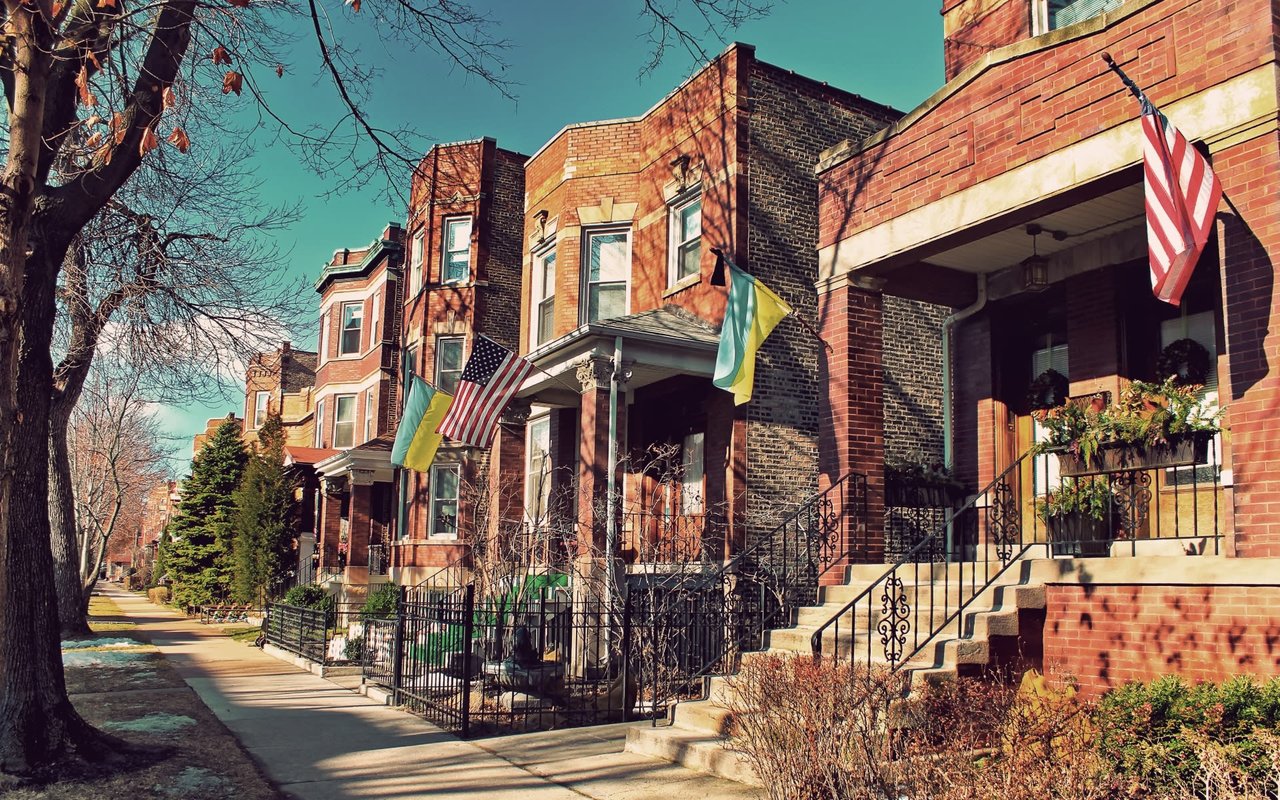
Ukrainian Village developed in the late 1800s as a working-class neighborhood, and much of that housing stock survives: brick workers' cottages dating to the 1880s, two- and three-flats, and stately greystones. Many homes retain original woodwork, stained glass, and masonry details. Side streets are mostly residential and quieter than the busier corridors in neighboring Wicker Park.
A Living Ukrainian Heritage
The neighborhood takes its name from the Ukrainian immigrants who settled here beginning in the late 19th century, and that community remains very much present. Landmarks include:
- St. Nicholas Ukrainian Catholic Cathedral, with its striking domes
- Holy Trinity Orthodox Cathedral, designed by Louis Sullivan
- Sts. Volodymyr and Olha Ukrainian Catholic Church and St. Volodymyr Ukrainian Orthodox Cathedral
- The Ukrainian National Museum and the Ukrainian Institute of Modern Art
Each summer, the Ukrainian Village Fest fills the neighborhood with music, food, and dancing, and churches host festivals and carnivals throughout the year.
One of Chicago's Best Dining Neighborhoods
Chicago Avenue and the surrounding blocks have become a destination for food lovers. Kasama, the Filipino bakery-by-day, tasting-menu-by-night restaurant, was elevated to two Michelin stars in 2025, and Feld earned its first Michelin star the same year — both in Ukrainian Village. Traditional spots like Tryzub Ukrainian Kitchen sit alongside neighborhood taverns, coffee shops, and bakeries, and Wicker Park's shops and restaurants along Division Street and Milwaukee Avenue are a short walk north.
Ukrainian Village Housing Market
Measure | Latest | Year Over Year |
|---|---|---|
Median sale price | $767,500 | Up 7.3% |
Median price per square foot | $394 | Up |
Sale-to-list price | 100.4% | Up 2.3 points |
Homes sold above list price | 40.9% | Up 11.3 points |
Median days on market | About 52 | Up about 3 days |
Source: Redfin, three months ending March 2026. Ukrainian Village sees a relatively small number of sales each month, so figures can swing from period to period, and the mix of homes sold (a single-family home versus a condo, for example) has a big effect on medians.
What the numbers mean: prices are rising, and well-priced homes draw competition — four in ten recent sales closed above asking. The median days-on-market figure is pulled up by homes that are overpriced or need work; desirable, well-presented homes often go under contract much faster.
That matches what we see next door. Our Wicker Park market report shows half a month of supply and a 9-day median market time, and Bucktown's median has crossed $1 million. Chicago-area inventory has been shrinking even as it grows nationally, which keeps pressure on prices across this part of the city.
Higher mortgage rates are the main counterweight: with the 30-year fixed above 7% this fall, buyers are more payment-conscious. For the bigger picture, see our Chicago housing market outlook.
Types of Homes in Ukrainian Village
- Workers' cottages: modest brick or frame homes from the late 1800s, often expanded or fully renovated. Popular with buyers who want a single-family home with vintage character.
- Two- and three-flats: the classic Chicago multi-unit building. Owner-occupants can live in one unit and rent the others, and many have been converted to condos or deconverted to single-family homes.
- Greystones and larger single-family homes: fewer in number and among the most sought-after properties.
- Condos and townhomes: both vintage conversions and newer construction, offering a lower entry price. If you're financing a condo, review the association's finances closely — new Fannie Mae and Freddie Mac reserve rules take effect in January 2027.
Most homes here are a century old or more, so a solid inspection matters. Our vintage home maintenance guide covers what to look for, from tuckpointing to lead service lines.
What the Ukrainian Village Landmark District Means for Owners
Part of the neighborhood is a designated Chicago Landmark District. The Ukrainian Village District was created in 2002 to protect its rows of 1880s brick workers' cottages and was expanded in 2005 and 2007 to cover additional blocks of cottages and flats, including stretches of Walton, Iowa, Rice, Thomas, Cortez, and Augusta streets.
- Exterior changes need review. Work on a contributing building's street-facing exterior — windows, masonry, porches, additions — generally requires approval from the Commission on Chicago Landmarks before the City issues a permit.
- Demolition is restricted for buildings that contribute to the district's character.
- Interiors aren't regulated. You can renovate kitchens, baths, and layouts as you would anywhere else, subject to normal permits.
- It protects the streetscape. Many buyers see designation as a plus: the character of the block is less likely to change around them.
If you're buying in or near the district and planning exterior work or an addition, confirm the property's status and talk to the City's historic preservation staff before you finalize your budget.
Pros and Cons of Living in Ukrainian Village
Pros | Cons |
|---|---|
Vintage character — historic homes and a protected landmark district | Limited inventory — few homes for sale at any given time |
Walkability — restaurants, cafés, and Wicker Park nearby | Rising prices — competition pushes well-priced homes above list |
Close to downtown — a short drive, bus, or Blue Line ride to the Loop | No L stop inside the neighborhood — Blue Line stations are a walk or bus ride away |
Destination dining — including two Michelin-starred restaurants | Tight street parking — permit zones on many blocks; garage spaces are valuable |
Strong community and culture — churches, museums, and festivals | Older homes need upkeep — masonry, plumbing, and systems can be costly |
A note on neighborhood change: like much of West Town, Ukrainian Village has seen significant reinvestment over the past two decades, with rising prices and new construction. Long-time residents and institutions continue to shape the neighborhood's identity, and the landmark district helps preserve its historic fabric — but affordability is a real consideration, for buyers and for the community.
Getting Around Ukrainian Village
- CTA buses: routes 70 (Division), 66 (Chicago), and 65 (Grand) run east to downtown, and 50 (Damen) and 49 (Western) run north-south.
- Blue Line: the Division and Damen stations are a short walk or bus ride north and east of the neighborhood, with service to the Loop and O'Hare.
- Driving: the Kennedy Expressway (I-90/94) is a few minutes east.
- Biking: the neighborhood is flat, with bike lanes on several nearby streets and Divvy stations throughout the area.
- Parking: many blocks have residential permit parking. Homes with an alley garage or parking pad command a premium — and are worth prioritizing if you own a car.
How to Buy a Home in Ukrainian Village
- Get fully pre-approved. With rates where they are, know your budget at today's rate, and compare more than one lender. Ask about strategies like using a seller credit to buy down your rate.
- Work with an agent who knows the blocks. Pricing varies a lot between a renovated cottage, a vintage two-flat, and a new-construction condo — and between blocks inside and outside the landmark district.
- Be ready to move quickly. The best homes draw multiple offers. Tour early, and have your lender and attorney lined up before you find the one.
- Write a clean, competitive offer. Price is only one lever; flexible timing and a strong pre-approval matter too.
- Inspect thoroughly. For a vintage home, consider a sewer scope and ask about the masonry, roof, and plumbing history. For a condo, review the association's budget and reserves.
Frequently Asked Questions
Where exactly is Ukrainian Village in Chicago?
On Chicago's West Side, about three miles northwest of the Loop, within the West Town community area, roughly bounded by Division Street to the north, Grand Avenue to the south, Damen Avenue to the east, and Western Avenue to the west. Wicker Park is directly north.
Is Ukrainian Village a good place to live?
For many people, yes. It offers historic homes, quiet residential streets, a strong community, excellent restaurants, and quick access to downtown. The main drawbacks are high demand and prices, limited parking, and no train stop within the neighborhood itself.
How much does a home cost in Ukrainian Village?
Recent sales have had a median price of about $767,500, but prices range widely — from condos well below that to renovated single-family homes and greystones well above it. Ask us for recent sales of homes like the one you're considering.
What's the difference between Ukrainian Village and Wicker Park?
Wicker Park, to the north, is busier, with more nightlife and retail along Milwaukee Avenue and Division Street, plus a Blue Line stop. Ukrainian Village is more residential and quieter, with a stronger concentration of 19th-century homes and its distinct Ukrainian cultural institutions.
Can I renovate a home in the Ukrainian Village landmark district?
Yes. Interior renovations follow normal permitting. Exterior changes visible from the street on contributing buildings — and any demolition — generally require review by the Commission on Chicago Landmarks before the City issues a permit.
Is Ukrainian Village Right for You?
If you want historic character, a real sense of community, great food, and a short trip downtown, Ukrainian Village belongs at the top of your list. Just go in prepared: inventory is limited, the best homes move quickly, and vintage homes reward buyers who know what to look for. Whether you're buying your first home, moving up, or investing in a two-flat, local knowledge makes the difference.
Thinking of Buying or Selling in Ukrainian Village?
The Camille Canales Group works across Ukrainian Village, Wicker Park, and Chicago's North and Northwest Side. Whether you want to know what your home is worth or how to compete for the right one, we're happy to talk.
Market data from Redfin; data deemed reliable but not guaranteed. Neighborhood boundaries vary by source. Landmark district information is general; confirm a specific property's status and requirements with the City of Chicago. Restaurant and business information is subject to change.