The Northwest Side Preservation Ordinance — known as 606 TOPA — requires a specific sequence of steps before you can sell a rental property in Chicago's Logan Square, Avondale, Hermosa, Humboldt Park, or West Town. Skip a step, do them out of order, or miss a deadline, and you're looking at fines of up to $1,000 per day — and potentially a derailed closing.
This checklist covers every required action in the sequence you need to complete it. We've built it from our direct experience representing sellers under this ordinance, most recently at 2913 N. Sacramento Ave. — a tenant-occupied 3-flat that sold for $860,000 in May 2025.
Related Reading
Understanding Chicago's Northwest Side Preservation Ordinance: What Home Buyers and Sellers Need to Know — our full overview
What We Learned Representing Sellers Under the Northwest Side Preservation Ordinance — our case study from a real transaction
Before You Begin: Confirm Coverage and Property Category
The ordinance only applies to properties in the designated coverage area. The first thing you need to know before any compliance step is (1) whether your property is covered, and (2) how many occupied rental units it contains, since all timelines flow from that.
☐ Confirm your address falls within the covered area (Logan Square, Avondale, Hermosa, Humboldt Park, or West Town). The City of Chicago Department of Housing maintains the official boundaries. When in doubt, check with your agent or a real estate attorney.
☐ Count the occupied rental units in your building as of the date you intend to begin the process. A coach house, basement unit, or unlicensed unit may still count. This determines your required notice periods.
☐ Review lease terms for all tenants. Month-to-month and long-term lease tenants both have rights under the ordinance. Know who is in each unit and confirm their tenancy status.
☐ Consult a licensed real estate attorney. This checklist is a starting framework. Your attorney will review your specific situation and advise on any details that affect your compliance approach.
Quick Reference: Your Required Timelines by Property Size
Property Size | Notice Period | Tenant Response Window | Tenant Must Provide |
|---|---|---|---|
1–2 Occupied Units | 15 days | 15 days | Lender pre-approval |
3–4 Occupied Units | 30 days | 30 days | Lender pre-approval |
5+ Occupied Units | 60 days | 90 days | Letter of intent from financial institution |
Phase 1: Issue the Notice of Intent to Sell
This is the formal start of the compliance clock. The notice must be delivered before you list the property or accept any contracts. Everything in Phase 2 and beyond depends on this step being completed correctly.
☐ Prepare the Notice of Intent to Sell. The notice must include: your name and contact information as seller, the property address, the number of units, the asking price, a statement of tenant rights under the ordinance, and the City of Chicago Department of Housing contact information.
☐ Deliver the notice to every tenant in writing. Use certified mail, personal delivery with a signed receipt, or another documented method. Text messages and informal email do not meet the documentation standard.
☐ File the notice with the City of Chicago Department of Housing (DOH). Delivery to tenants alone is not sufficient. The DOH must also receive a copy.
☐ Post the notice at every building entrance. Physical posting at each entry point is required in addition to direct tenant notification.
☐ Record the delivery date. The response window starts from the date tenants received the notice, not the date you sent it. Keep a dated record of confirmed delivery.
Phase 2: The Tenant Response Window
Once the notice is delivered and confirmed, the waiting period begins. During this window, you may market the property freely — but you cannot execute a purchase contract with an outside buyer.
☐ Begin marketing the property. You can list on the MLS, hold showings, and collect buyer interest during the notice period. Use this time productively — the goal is to have outside buyers ready to move quickly once the window closes.
☐ Document any communication from tenants about intent to purchase. If a tenant expresses interest, note the date and method of communication. This does not constitute a formal exercise of the right — tenants must follow up with the required financial documentation.
☐ Track the response deadline for each tenant. Each tenant's window runs from their individual confirmed delivery date. If you delivered notice to two tenants on different days, their deadlines may differ slightly.
☐ If a tenant provides a pre-approval letter or letter of intent: This constitutes a formal exercise of the right to purchase. You cannot proceed with an outside buyer until the tenant either withdraws interest, fails to close within the required timeline, or the time period set by ordinance elapses. Consult your attorney immediately.
☐ Request written acknowledgment from tenants who decline or do not respond. If a tenant tells you verbally or in writing that they are not interested in purchasing, get that in writing. A signed declination from a tenant is cleaner documentation than a lapsed deadline alone.
☐ Confirm all response windows have closed before proceeding to contract. Do not accept or execute a contract with an outside buyer until every tenant's response window has expired without a qualifying exercise of the right to purchase.
Phase 3: Accept a Contract and Go Under Contract
Once all response windows have closed without a qualifying tenant offer, you may proceed with your outside buyer. The compliance documentation from Phases 1 and 2 now becomes part of the transaction file.
☐ Compile your compliance documentation packet. This should include: a copy of the Notice of Intent to Sell, proof of delivery to each tenant, proof of filing with DOH, proof of posting at building entrances, dated record of the response window for each tenant, and any written declinations or documentation of non-response.
☐ Provide compliance documentation to the buyer's attorney at contract. Experienced buyer's attorneys in these neighborhoods will request this documentation. Having it organized at the time of contract avoids delays later.
☐ Disclose the ordinance to your buyer. Buyers of rental properties in covered areas inherit certain obligations if they resell — they should understand what they're buying. This is both a best practice and a potential point of negotiation in some transactions.
☐ Proceed through attorney review, inspection, and mortgage contingency. These steps follow the standard Illinois contract timeline. The ordinance compliance work is complete at this point.
Phase 4: Prepare for Closing
☐ Confirm your title company has the compliance documentation. The title company will typically review the Notice of Intent to Sell and response period documentation as part of their title search and commitment process.
☐ Coordinate tenant notification of closing date. Existing tenants remain in place through closing. Confirm they are aware of the sale and understand their lease obligations continue with the new owner.
☐ Provide the buyer with all tenant-related documents at closing. Leases, security deposits, rent rolls, and tenant contact information should transfer at closing. In Illinois, security deposits must be transferred to the new owner.
The Numbers to Keep in Mind
$200–$1,000 Fine Per Day Per offense for non-compliance with the ordinance | Up to 90 Days Maximum Wait For 5+ unit buildings before accepting an outside contract | 0 Days Lost Market Time When compliance is completed before listing (as we did on Sacramento) |
Checklist FAQs
Can I run the compliance period and the listing simultaneously?
You can market the property during the tenant response window — but you cannot accept a contract with an outside buyer until the window closes. Listing while the notice period is still running is allowed and advisable for many sellers. Accepting an offer while the window is still open is not.
What if a tenant moves out during the compliance period?
The ordinance obligations attach at the time the notice is issued. If a tenant was in place when you delivered the Notice of Intent to Sell, they retain their right to purchase during the response window, regardless of whether they subsequently vacate. Consult your attorney on this scenario.
How long does this process realistically add to a sale?
For most 3–4 unit properties, the compliance work adds 30–45 days to the pre-listing phase. When started before the property goes on the MLS, it adds zero days to active market time. Our Sacramento Avenue transaction went under contract in 18 days from list date — the ordinance compliance had no impact on that number because we completed it first.
Do I need to use the city's official notice form?
The City of Chicago's Department of Housing has specific content requirements for the Notice of Intent to Sell. Using the official form or one drafted to those exact specifications is the safest approach. Your real estate attorney should prepare or review the notice before delivery.
Are You in the Covered Area?
The ordinance applies to properties within the defined Northwest Side boundary. If your property is in Logan Square, Avondale, Hermosa, Humboldt Park, or West Town, it's very likely covered. The map below shows the full coverage area.
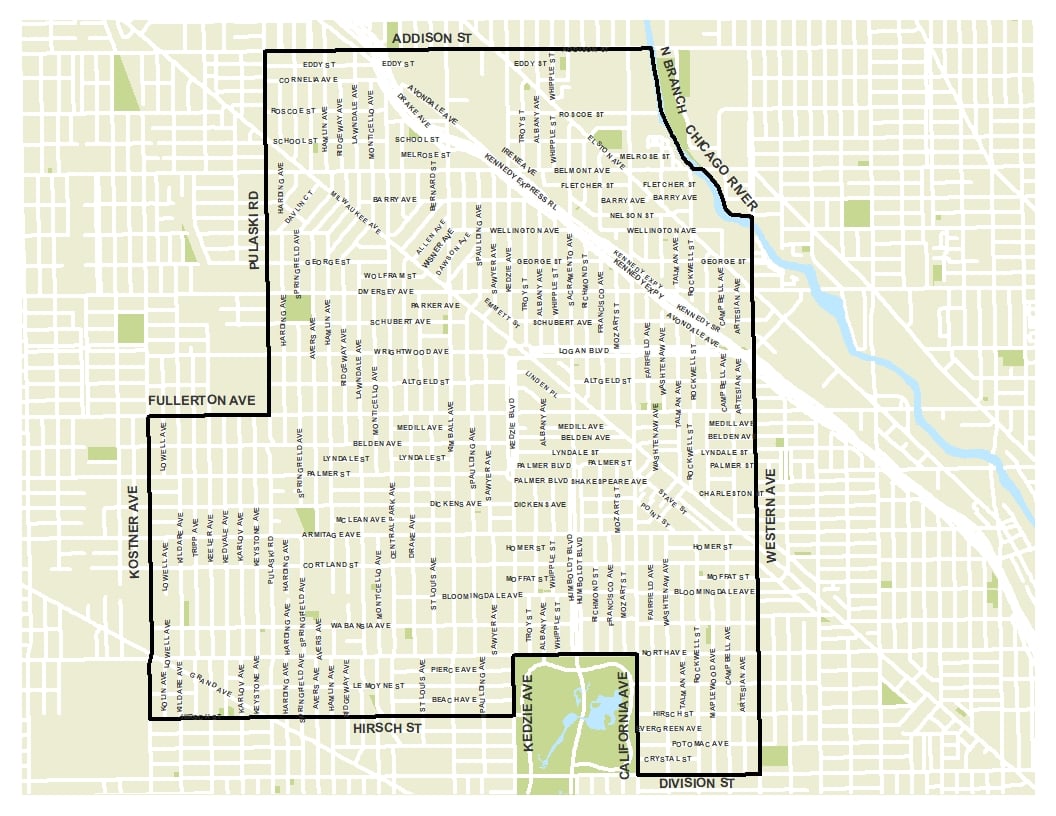
Not certain whether your address is in the covered zone? Contact us — we can usually give you an answer in minutes and point you toward next steps.
Ready to Sell? Let's Talk Compliance First.
The Camille Canales Group has represented sellers under 606 TOPA and knows how to keep your timeline on track. Reach out before you list.
Call 773-377-9200Send Us a Message
This checklist is for general informational purposes and reflects the Camille Canales Group's experience with the Northwest Side Preservation Ordinance as of publication. It does not constitute legal advice. Requirements may change. Consult a licensed Illinois real estate attorney for guidance specific to your transaction.