Chicago is one of those cities that tends to exceed expectations. People arrive knowing about the deep dish and the wind and the architecture, and they leave — or they don't leave, because they stayed — understanding that the city is considerably more than its reputation. It's a place that rewards actually being in it, walking it, eating in it, living in it.
If you're seriously considering a move to Chicago, this is the guide we wish existed when our own team members made the move themselves. CCG Chicago founder Camille Canales relocated from Austin, Texas in 2004. Agent Bridget Smith moved from New York City in 2011. Between them, and across hundreds of relocation clients over two decades, we've developed a clear sense of what people need to know before they arrive — and what tends to surprise them once they do.
The Thing Nobody Tells You: Chicago Is a City of Neighborhoods
Before we get into checklists and logistics, this is the most important thing to understand about Chicago, because it shapes everything else including where you should live, how your daily life will feel, and what kind of property makes sense for you.
Chicago is not a monolithic city. It is a collection of distinct neighborhoods, each with its own architecture, its own commercial character, its own demographic mix, its own feel. Wicker Park is not Lincoln Park. Logan Square is not River North. Bucktown is not Hyde Park. The differences between them are not subtle — they are pronounced enough that choosing the wrong neighborhood for your lifestyle is a real risk, and finding the right one is genuinely life-changing.
Camille describes it as feeling like a series of small cities within a larger one, and that's exactly right. When she arrived from Austin in 2004, the neighborhood structure of Chicago was one of the first things that caught her off guard — in the best possible way. Twenty years later, teaching newcomers about those neighborhoods is one of her favorite parts of the job.
This matters practically because your neighborhood search and your property search are inseparable in Chicago. Before you know what you're looking for in a home, you need to have a sense of where you want to live — and that requires either time on the ground or a guide who knows the city well enough to ask the right questions about how you actually want to live.
The Neighborhoods: A Starting Point
There are 77 officially recognized neighborhoods in Chicago. We're not going to cover all of them here, but we'll give you a useful starting framework for the areas where we most often help relocation buyers land.
Lincoln Park is the neighborhood we'd call the most quintessentially Chicago — the one that tends to match what people picture when they imagine living in the city. It sits along the lakefront with the park itself as a front yard, the architecture is exceptional (significant amounts of original 19th-century housing stock, greystones, brownstones, and vintage two-flats), the schools are among the strongest in the city, and Armitage and Clark Streets give the neighborhood a walkable, retail-rich Main Street quality. It's consistently one of the strongest long-term real estate investments in Chicago, and it tends to resonate immediately with buyers coming from established urban neighborhoods in New York, DC, or other major cities.
Wicker Park and Bucktown occupy a stretch of the city that has been consistently desirable for decades. Dense, walkable, connected by the 606 elevated trail, full of independent restaurants, vintage shops, and live music venues. CCG Chicago's office is in this neighborhood, and we know it extremely well. The housing mix includes vintage condos, single-family greystones, and newer construction townhomes. For buyers who want urban energy without being in the downtown core, this corridor is hard to beat.
Logan Square sits just west of Bucktown and has been one of the city's most compelling buys over the past decade. The grand boulevard system, the two- and three-flat building stock, the restaurant scene on Milwaukee Avenue — it has a genuine neighborhood character that attracts buyers with an eye for value and a longer investment horizon. For relocation buyers interested in multi-unit properties, Logan Square is one of our first recommendations: buy a two- or three-flat, live in one unit, rent the others, and let the building help carry the costs. Several of our relocation clients have done exactly this, including buyers from California who purchased multi-unit homes in Logan Square and Lincoln Park.
River North appeals to buyers who want to stay close to downtown — walkable to Michigan Avenue, the Riverwalk, and the city's best hotel and restaurant density. The condo market here is strong, and it's a natural fit for buyers coming from high-density, amenity-rich environments who aren't quite ready to trade that lifestyle for something quieter. We recently helped a client who relocated from Washington DC purchase a condo in River North — they specifically noted the space-to-price ratio as one of the deciding factors in choosing to buy rather than rent.
Beyond these: Bucktown bleeds into Wicker Park in ways that make them worth considering together. Ukrainian Village, just south of Wicker Park, has become one of the city's more interesting value plays. Lakeview and Boystown sit north of Lincoln Park with strong walkability and a vibrant social scene. Andersonville further north has a particular character — independent, community-minded, deeply residential — that attracts a loyal following. Lincoln Square has the architecture and the neighborhood feel of Lincoln Park with slightly more room to breathe.
If you're open to the suburbs, Evanston sits just north of the city on the lakefront and has a genuine urban character of its own. Naperville to the west is consistently ranked among the best places to live in Illinois. These are worth a separate conversation depending on your priorities around schools, commute, and space.
What Chicago Costs: An Honest Look
Chicago offers real value relative to coastal cities, and that's not spin — it's one of the most common things relocation buyers tell us after they've done the math.
For buyers coming from New York or California specifically, the price-per-square-foot comparison in most Chicago neighborhoods is favorable enough to be genuinely surprising. Buyers who might be priced out of ownership in their current city find that Chicago puts ownership within reach — and in many cases, ownership of something with character and history rather than new construction in a less desirable location.
The median home price in Chicago proper varies significantly by neighborhood, which is why neighborhood selection and budget planning need to happen in conversation with each other. Broadly: Lincoln Park and River North tend to represent the higher end of the market in the city proper. Logan Square, Wicker Park, and Bucktown sit in a strong mid-range that offers excellent value for what you get. Neighborhoods like Ukrainian Village and Andersonville offer compelling entry points for buyers who are willing to be slightly further from the obvious anchors.
Property taxes in Illinois are worth understanding before you buy. They are higher than many states, and they are factored into your carrying costs in a way that matters to your overall affordability calculation. A good buyer's agent will walk you through this in detail — it's not a reason to avoid buying in Chicago, but it's something to understand clearly before you make an offer.
If you're renting first while you figure out the city — which we often recommend for buyers who haven't spent time on the ground — Chicago's rental market is competitive but more forgiving than New York or San Francisco. Renting for six to twelve months in a neighborhood you're considering can be one of the best investments you make before you buy.
The Architecture: A Genuine Differentiator
This gets its own section because it's genuinely one of Chicago's most extraordinary assets and one that relocation buyers often don't fully appreciate until they're standing in front of a greystone for the first time.
Chicago was largely rebuilt after the Great Fire of 1871, which means a significant portion of the city's existing housing stock dates to the late 19th and early 20th centuries. That era produced some of the most beautiful residential architecture in America: Italianate greystones, Queen Anne two-flats, Chicago bungalows, Prairie Style homes influenced by Frank Lloyd Wright, ornate courtyard buildings from the 1920s. Buying a home in Chicago often means buying something with genuine history in its walls — and for buyers who care about that, it's a profound differentiator from markets dominated by newer construction.
Camille's entry into real estate was through exactly this kind of property. Her first Chicago home was a multi-unit building originally constructed in the 19th century, and that purchase sparked a career-long fascination with the city's historic housing stock. She brings that knowledge — of what to look for, what to watch out for, what the architecture tells you about a building's bones — into every relocation buyer consultation.
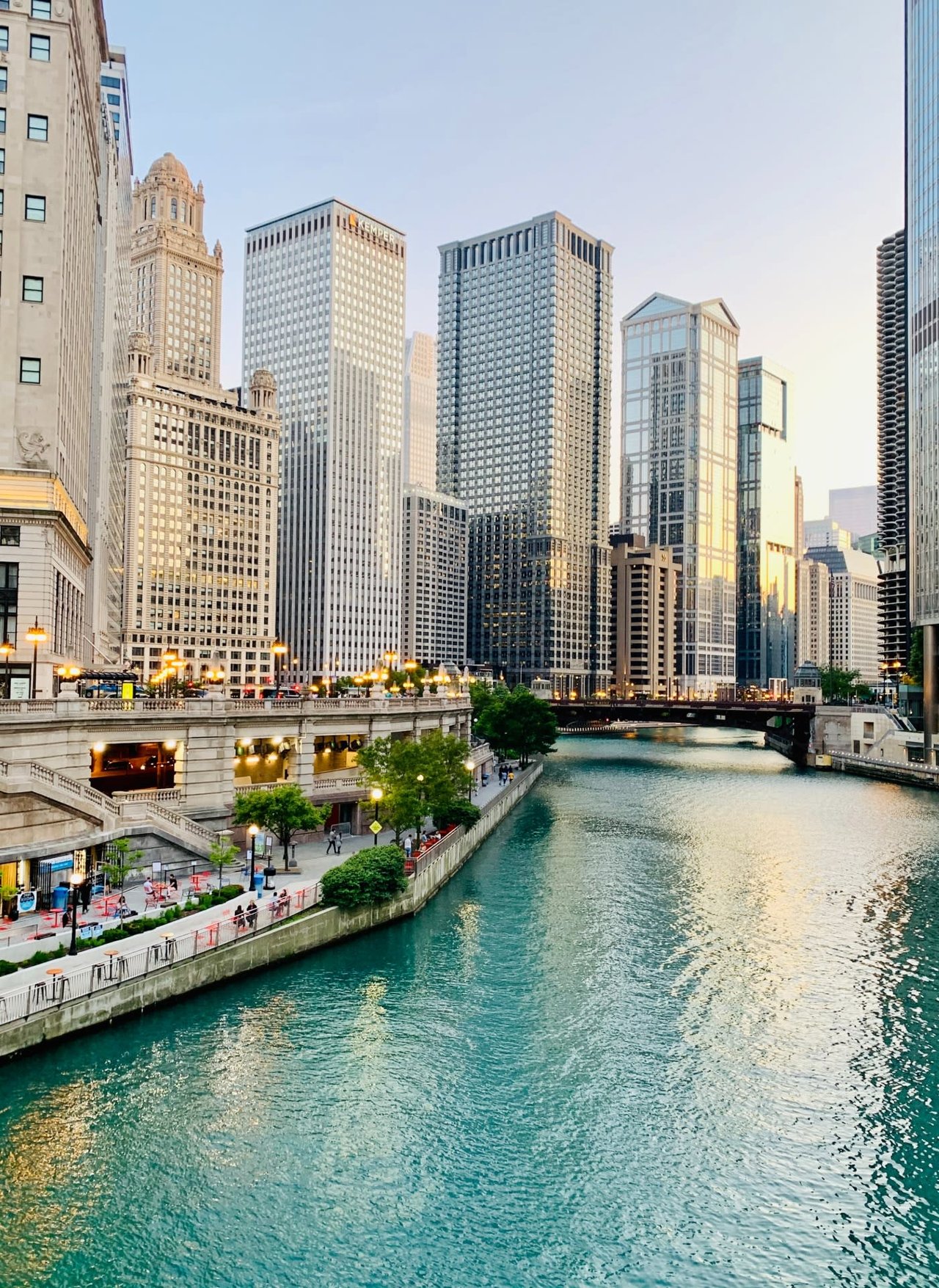
Beyond residential, Chicago's architectural heritage is world-class in every direction. The skyline, the Chicago Riverwalk, the lakefront, the neighborhood commercial corridors with their intact vintage storefronts — the built environment here is one of the city's greatest pleasures, and it rewards attention.
The Lakefront and Quality of Life
Lake Michigan is not background scenery. This is something that catches a lot of relocators off guard — the assumption that a lake is a nice amenity, not a central feature of daily life. In Chicago, it is genuinely central.
The 18-mile lakefront trail runs along the water from the South Side to the North Side, connecting beaches, parks, harbors, and neighborhoods. It's where Chicagoans run, bike, walk, kayak, and simply sit. The beaches are real beaches — sandy, populated in summer, dramatic in winter. Millennium Park and Grant Park anchor the downtown lakefront with some of the best public space in any American city. Bridget Smith, who moved from New York in 2011, counts the Riverwalk and the lakefront as among the primary reasons she has never seriously considered leaving.
Beyond the lake: Chicago has world-class museums, a restaurant scene that holds up against any city in the country, a live music culture (particularly in jazz and blues) that is historically significant, major league sports across every major sport, and a theater scene anchored by the Steppenwolf and the Goodman that produces work that regularly moves to Broadway. The quality of life argument for Chicago is not a difficult one to make.
The Winter: An Honest Assessment
We're not going to bury this. Chicago winters are cold. The wind off the lake is real — "the Hawk" is not a myth — and January in Chicago is a genuinely serious month. If you're relocating from Austin, Miami, Los Angeles, or San Diego, the first winter will be an adjustment.
Here's what we've observed across years of working with relocation buyers: almost everyone finds the first winter harder than expected and subsequent winters more manageable. The city is built for cold — the infrastructure, the restaurant culture, the covered walkways in the Loop, the neighborhood bars that become genuinely essential in February. You adapt, and then spring arrives and you understand why Chicagoans treat it like a religious event. There is no spring quite like a Chicago spring after you've earned it.
A few practical notes: invest in real cold-weather gear before you arrive, not after. A proper winter coat, waterproof boots, and layers are not optional. If you're choosing between neighborhoods, consider proximity to the L train — on the coldest days, minimizing time outside matters more than you'd think.
A Relocation Checklist: Before, During, and After
Before you arrive:
Spend time on the ground in the neighborhoods you're considering before committing to a property. Even a long weekend of walking, eating, and taking the L through a few areas will tell you more than weeks of research online. If you can't visit before you need to make decisions, work closely with an agent who can be your eyes and ears and who knows how to ask the right questions about your lifestyle.
Get pre-approved before you start your search in earnest. The Chicago market moves quickly in desirable neighborhoods, and having your financing in order means you can act when the right property appears. Understand Illinois property taxes early — your agent should walk you through this as part of your affordability conversation, not as a footnote.
Think about your commute before you choose a neighborhood. Chicago has excellent transit in some corridors and limited transit in others. If you'll be commuting to the Loop or to a specific employment center, map the L lines and bus routes before you fall in love with a particular neighborhood.
During your search:
Resist anchoring too quickly on one neighborhood. This is the most common mistake relocation buyers make. Chicago rewards exploration, and the neighborhood that seemed right from the outside sometimes gives way to a different one once you're actually walking it. Keep an open mind through at least the first few showings.
In Chicago's vintage two- and three-flat market, inspection matters enormously. Buildings with a century of history have a century of potential issues, and a thorough inspection with a knowledgeable inspector — and an agent who understands historic construction — is not a place to cut corners.
Consider the multi-unit option seriously. If you're open to it, buying a two- or three-flat and renting unused units is one of the most effective ways to enter the Chicago market. It's a strategy with a long history in this city, and done well, it can significantly reduce your carrying costs.
After you arrive:
Join your neighborhood's block club or local Facebook group. Chicago has strong neighborhood community organizations, and connecting with them early will accelerate your sense of belonging considerably. Explore beyond your immediate neighborhood systematically — take the L somewhere new on weekends, try restaurants in neighborhoods you haven't visited, use the lakefront trail to move through the city at a human pace. The city reveals itself gradually and rewards the effort.
Working with CCG Chicago on Your Relocation
Relocation buyers are a significant part of what we do, and we approach them differently than local buyers — because the process is genuinely different. When you're buying in a city you don't yet know well, the neighborhood consultation comes before the property search. Understanding how you want to live precedes finding where to live. And the logistics of remote purchasing — making competitive offers, navigating inspections from out of town, managing timing around a move — require a team that has done it many times before.
Camille and the CCG Chicago team have guided buyers from New York, California, Texas, DC, and beyond through this process. The reviews from those clients speak to what the experience is like — the white-glove service, the market knowledge, the steady hand through what can be a genuinely stressful process.
If you're moving to Chicago and want to start the conversation, reach out to us. We're happy to talk through neighborhoods, timing, and what to expect long before you're ready to make an offer. That's where the good work begins.